
- (Topic 2)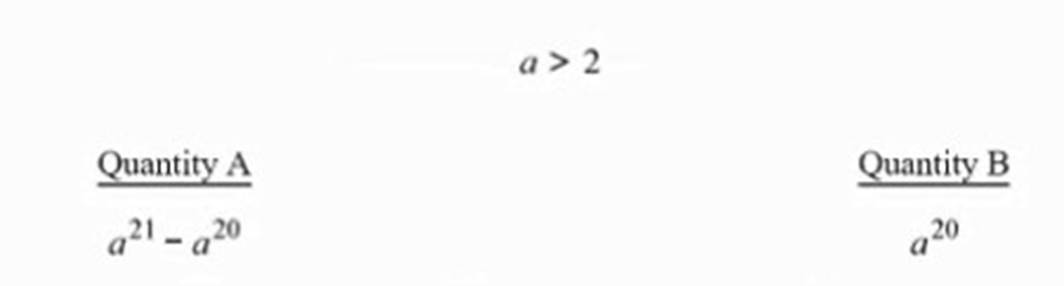
Correct Answer:
A
- (Topic 2)
An investor purchased two properties. A and B. The investor later sold property A at a selling price that was 20 percent more than the purchase price of A. and the investor sold property B at a selling price that was 40 percent less than the purchase price of B. If the combined purchase price of properties A and B was S200.000 and the combined selling price was S210.000. what was the selling price of property A ?
Correct Answer:
C
- (Topic 3)
When Flemish painter Anthony Van Dyck moved to England in 1632 to become court painter to Charles The introduced an entirely new way of representing dress in portraiture. In women's portraits. he left off fashionable accessories, depicted subjects in unbuttoned sleeves and collars, and added lavish drapery and jewels. For the first time an artist actively participated in dressing his subjects, creating an amalgam of fantasy and reality. While Van Dyck was most innovative when representing women, he used similar elements in portraits of men.
Van Dyck's Portrait of Thomas Killigrew and Willian. Lord Crofts (1638) demonstrates how the artist relaxed and unbuttoned men's dress to accord with an underlying theme. The double portrait may be seen as an essay in grief: Killigrew. a poet and playwright, had lost his wife Cecelia to the plague shortly before the sitting, and Crofts was her nephew. The painting contains clear references to the situation at hand. The background features a broken column, a traditional emblem of earthly transience. A drawing in Killigrew's right hand depicts two Itinerary monuments. Crofts holds a blank sheet of paper, seen by some scholars as an analog to the drawing Killigrew holds: a symbol of what is gone.
At historians have interpreted the clothing depicted in this portrait, particularly Crofts' doublet which is worn unbuttoned in back, as an allusion to the subjects' grief-stricken distraction. It is true that Killigrew's dress includes references to his loss—he wears a cross inscribed with his wife's initials. There is an intimate nature to this painting, which seems underscored by the loose clothing worn by both subjects. However, diis reading of the costumes as signs of grief does not take account of seventeenth-century fashion conventions. Only Killigrew appears in noticeably disheveled attire;
Crofts" dress would be quite appropriate for a formal portrait. Though black clothing, such as that won by Crofil, was common for mourning, it was also ordinary on other occasions. Furthermore, during the first stage of mounting no shiny surfaces, such as Crofts' satin doublet, would be permitted. The unbuttoned slit on Crofts" doublet was probably a matter of style: a French courtier in a 1635 fashion print by Bosse. who is gallivanting rather than grieving, wears a similarly undone doublet. Evidence suggests that by the late 1630s a certain calculated looseness was conventional in men's formal dress. Ribeiro. for example, cites the writings of moralists objecting to this style.
Killigrew's attire, though even looser than Crofts", should not necessarily be associated with grief. Other seventeenth-century subjects depicted in melancholic states do not dress this way. Although Killigrew's "undress" lends this portrait a distinctive intimacy, it might also refer to Killigrew's literary career. Many of Van Dyck's other subjects who engaged in literary pursuits are depicted in loose clothing. The blank sheet held by Crofts may be a reminder not only of Killigrew's loss but also of his solace: he had but to express his grief in writing.
The passage suggests which of the following about Van Dyck's portraits of men?
Correct Answer:
E
- (Topic 3)
Mary Beard notes that the classical past has never been _____ by only one political tendency or party: the classics have been used in support of revolutions as well as dictatorships.
Correct Answer:
D
- (Topic 3)
Discussions of the collapse of the lowland Maya are not new. However, it might be better to say that Maya civilization as a whole did not collapse, although many zones did experience profound change. Because societies are not bounded, unitary entities. collapses are rarely total, and continuity is a normal part of collapse. At the end of the Classic period [200-900 C.E.]. the institution of divine kingship and many of the well-known markers of elite culture such as caned slelae [slabs erected for funerals or commemorative purposes] and hieroglyphic polychromes [multicolored artistic pottery] ended, but Maya civilization continued in modified form with many important features intact (e.g.. literacy, war. art. the production of fine ceramics). In some cases large buildings were constructed in the Postclassic period [900-1512 C.E.], but the transition to the Early Postclassic [900-1200 CXj era is distinctive for a decrease in elite goods and contexts. The variability in artifact changes during the Terminal Classic [800-900 C.E.] and into the Postclassic. even within artifact classes (e.g., fine versus unslipped ceramics), suggests weaker centralized control than during the Classic period. Site abandonments in the Terminal Classic indicate the collapse of the functional ability of Maya states, but sites that survived show that Maya civilization continued albeit without divine kingship and much of the spectacle around it.
The author would most likely characterize the claim that Maya civilization collapsed as
Correct Answer:
C