
- (Topic 3)
Adapting to its changing environment and building its own ecological niche in interactions with other disciplines, the scientific discipline of ecology can be seen as highly _____ .
Correct Answer:
C
- (Topic 3)
Though most physicists claim that the standard model of panicle physics is wrong, some prefer to say that the theory is _____ : it succeeds in answering certain questions but has nothing to say about others.
Correct Answer:
AE
- (Topic 3)
Recent research has questioned the long-standing view of pearly mussels as exclusively suspension feeders (animals that strain suspended particles from water) that subsist on phytoplankton (mostly algae). Early studies of mussel feeding were based on analyses of gut contents, a method that has three weaknesses. First, material in mucus-bound gut contents is difficult to identify and quantify. Second, material found in the gut may pass undigested out of the mussel, not contributing to its nutrition. Finally, examination of gut contents offers limited insight into the mechanisms and behaviors by which mussels acquire food. Modem studies suggest that pearly mussels feed on more than just algae and may use other means than suspension feeding. Pedal feeding (sweeping up edible material with a muscular structure called the foot) has been observed in juvenile pearly mussels.
Besides the phytoplankton pearly mussels capture from the water column, their guts also contain small animals, protozoans, and detritus (nonliving particulate organic material). Recent studies show that mussels can capture and assimilate bacteria as well, a potentially important source of food in many fresh waters. Another potential source of food for mussels is dissolved organic matter. Early studies showing that pearly mussels could take up simple organic compounds were largely discounted because such labile (unstable) compounds are rarely abundant in nature. Nevertheless, recent work on other bivalves suggests that dissolved organic matter may be a significant source of nutrition.
Of this complex mix of materials that pearly mussels acquire, what is actually required and assimilated? Stable-isotope analyses of mussels taken from nature and of captive-reared
mussels are beginning to offer some insight into this question. Nichols and Garling showed that pearly mussels in a small river were omnivorous, subsisting mainly on particles less than 2S micrometers in diameter, including algae, detritus, and bacteria. Bacterially derived carbon was apparently the primary source of soft-tissue carbon. However, bacteria alone cannot support mussel growth, because they lack the necessary long-chain fatty acids and sterols and are deficient in some amino acids. Bacteria may supplement other food resources, provide growth factors, or be the primary food In habitats such as headwater streams, where phytoplankton is scarce. Juvenile mussels have been most successfully reared m the laboratory on diets containing algae high in polyunsaturated fatty acids. Thus, it appears that the pearly mussel diet in nature may consist of algae, bacteria, detritus, and small animals and that at least some algae and bacteria may be required as a source of essential biochemicals.
The primary purpose of the passage is to
Correct Answer:
A
- (Topic 3)
Experimental magazine essays are quite in vogue, but many of the characteristic that now seem innovative will doubtless look (1) _____ in thirty years" time; a vaunted self- consciousness will look affected, a fractured style, far from appearing (ii) _____ will appear (lii) _____ instead.
Correct Answer:
CDE
- (Topic 2)
Exhibit.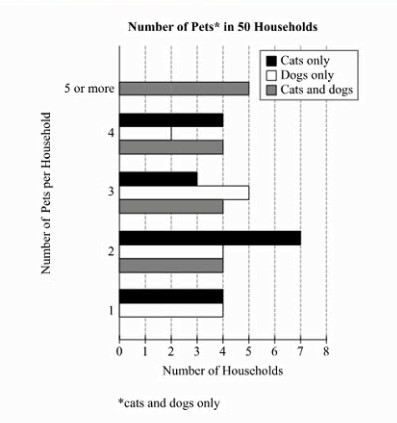
The 50 households are grouped according to the number of pets per household. For the group with the greatest number of households having cats only, how many households have dogs only?
Correct Answer:
D