
Which two statements are correct about using firewall filters on EX Series switches? (Choose two.)
Correct Answer:
AC
✑ A is correct because you can deploy only stateless firewall filters on an EX Series switch. A stateless firewall filter is a filter that evaluates each packet individually based on the header information, such as source and destination addresses, protocol, and port numbers1. A stateless firewall filter does not keep track of the state or context of a packet flow, such as the sequence number, flags, or sessioninformation1. EX Series switches support only stateless firewall filters, which are also called access control lists (ACLs) or packet filters2.
✑ C is correct because you can apply firewall filters to both Layer 2 and Layer 3 traffic on an EX Series switch. Layer 2 traffic is traffic that is switched within a VLAN or a bridge domain, while Layer 3 traffic is traffic that is routed between VLANs or networks3. EX Series switches support three types of firewall filters: port (Layer 2) firewall filters, VLAN firewall filters, and router (Layer 3) firewall filters4. You can apply these filters to different interfaces and directions to control the traffic
entering or exiting the switch.
Exhibit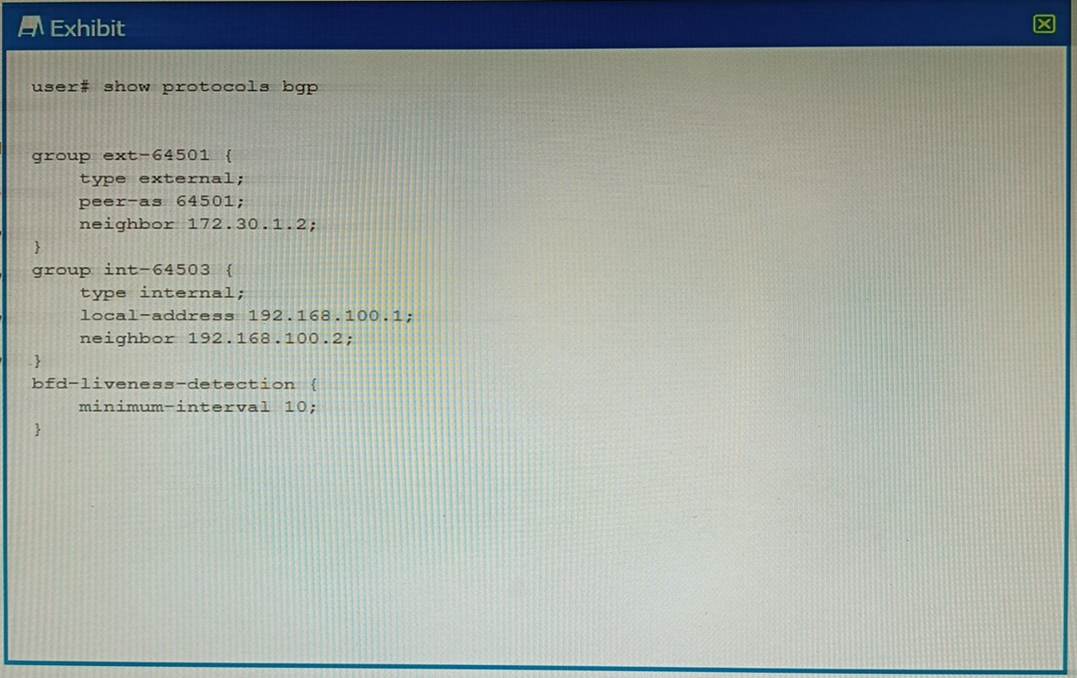
Your BGP neighbors, one in the USA and one in France, are not establishing a connection with each other.
Referring to the exhibit, which statement is correct?
Correct Answer:
B
✑ The exhibit shows the configuration of BFD liveness detection for BGP at the global level, which applies to all BGP neighbors by default1. However, this configuration does not specify the session mode, which determines whether BFD uses single-hop or multihop mode to communicate with a neighbor2.
✑ For single-hop BGP neighbors, which are directly connected on the same subnet, the session mode can be either automatic or single-hop. For multihop BGPneighbors, which are not directly connected and require multiple hops to reach, the session mode must be multihop2.
✑ Since your BGP neighbors are in different countries, they are likely to be multihop neighbors. Therefore, you need to configure the session mode as multihop for each neighbor individually at the [edit protocols bgp group group-name neighbor address bfd-liveness-detection] hierarchy level2. For example:
protocols { bgp { group usa { neighbor 192.0.2.1 { bfd-liveness-detection { session-mode multihop; } } } group france { neighbor 198.51.100.1 { bfd-liveness-detection { session-mode multihop; } } } } }
✑ If you do not configure the session mode for multihop neighbors, BFD will use the
default mode of automatic, which will try to use single-hop mode and fail to establish a BFD session with the remote neighbor2. This will prevent BGP from using BFD to detect liveliness and failover.
✑ Therefore, the answer B is correct, as you need to configure the BFD liveness
detection on the BGP neighbor level with the appropriate session mode for multihop neighbors.
You have DHCP snooping enabled but no entries are automatically created in the snooping database for an interface on your EX Series switch. What are two reasons for the problem? (Choose two.)
Correct Answer:
BC
The DHCP snooping feature in Juniper Networks?? EX Series switches works by building a binding database that maps the IP address, MAC address, lease time, binding type, VLAN number, and interface information1. This database is used to filter and validate DHCP messages from untrusted sources1.
However, there are certain conditions that could prevent entries from being automatically created in the snooping database for an interface:
✑ MAC limiting: If MAC limiting is enabled on the interface, it could potentially
interfere with the operation of DHCP snooping. MAC limiting restricts the number of MAC addresses that can be learned on a physical interface to prevent MAC flooding attacks1. This could inadvertently limit the number of DHCP clients that can be learned on an interface, thus preventing new entries from being added to the DHCP snooping database.
✑ Static IP address: If the device connected to the interface is configured with a
static IP address, it will not go through the DHCP process and therefore will not have an entry in the DHCP snooping database1. The DHCP snooping feature relies on monitoring DHCP messages to build its database1, so devices with static IP addresses that do not send DHCP messages will not have their information added.
Therefore, options B and C are correct. Options A and D are not correct because performing a DHCPRELEASE would simply remove an existing entry from the database1, and Dynamic ARP inspection (DAI) uses the information stored in the DHCP snooping binding database but does not prevent entries from being created1.