
You are asked to connect an IP phone and a user computer using the same interface on an EX Series switch. The traffic from the computer does not use a VLAN tag, whereas the traffic from the IP phone uses a VLAN tag.
Which feature enables the interface to receive both types of traffic?
Correct Answer:
D
The feature that enables an interface on an EX Series switch to receive both untagged traffic (from the computer) and tagged traffic (from the IP phone) is the voice VLAN12.
The voice VLAN feature in EX-series switches enables access ports to accept both data (untagged) and voice (tagged) traffic and separate that traffic into different VLANs12. This allows the switch to differentiate between voice and data traffic, ensuring that voice traffic can be treated with a higher priority12. Therefore, option D is correct.
Exhibit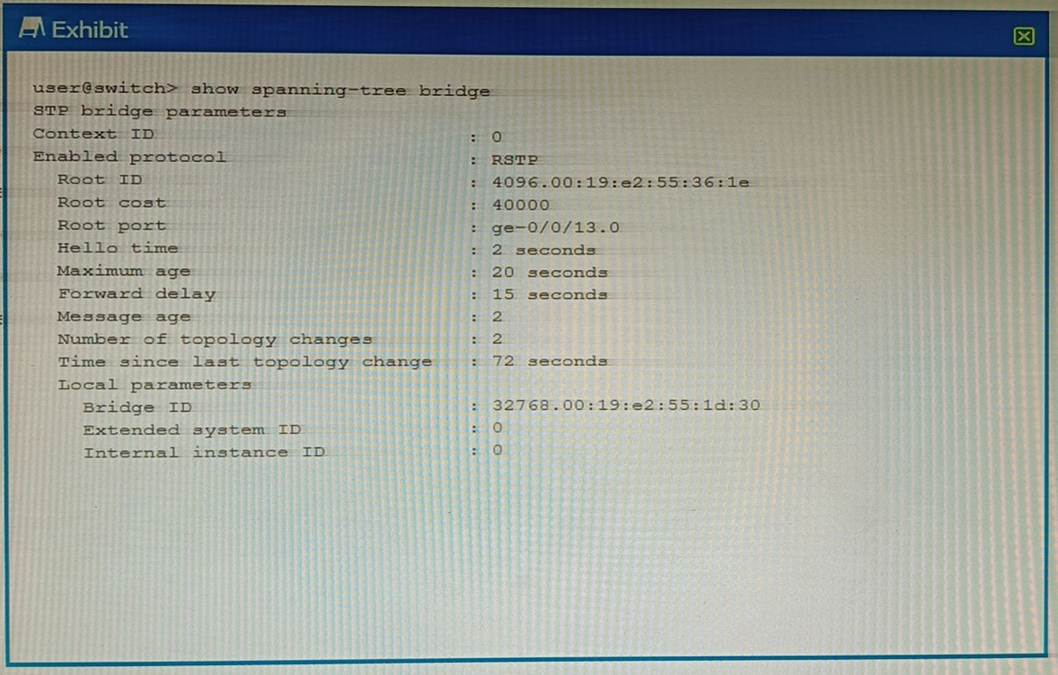
Referring to the exhibit, which statement is correct?
Correct Answer:
D
In a Rapid Spanning Tree Protocol (RSTP) topology, the root bridge is determined by the switch with the lowest bridge priority value12. If all switches have the same priority, then the root bridge is assigned to the switch whose MAC address??s hex value is the lowest2. The default bridge priority value is 3276832. However, without the actual exhibit, it??s difficult to definitively determine which device is the root bridge. But based on the options provided, if we assume that the local device has a lower bridge priority or a lower MAC address than other devices in the network, then it could be considered as the root bridge for this RSTP topology45.
Which two statements are correct about tunnels? (Choose two.)
Correct Answer:
BD
A tunnel is a connection between two computer networks, in which data is sent from one network to another through an encrypted link. Tunnels are commonly used to secure data communications between two networks or to connect two networks that use different protocols.
Option B is correct, because tunnel endpoints must have a valid route to the remote tunnel endpoint. A tunnel endpoint is the device that initiates or terminates a tunnel connection. For a tunnel to be established, both endpoints must be able to reach each other over the underlying network. This means that they must have a valid route to the IP address of the remote endpoint1.
Option D is correct, because tunnels add additional overhead to packet size. Tunnels work by encapsulating packets: wrapping packets inside of other packets. This means that the original packet becomes the payload of the surrounding packet, and the surrounding packet has its own header and trailer. The header and trailer of the surrounding packet add extra bytes to the packet size, which is called overhead. Overhead can reduce the efficiency and performance of a network, as it consumes more bandwidth and processing power2.
Option A is incorrect, because BFD can be used to monitor tunnels. BFD is a protocol that can be used to quickly detect failures in the forwarding path between two adjacent routers or switches. BFD can be integrated with various routing protocols and link aggregation protocols to provide faster convergence and fault recovery. BFD can also be used to monitor the connectivity of tunnels, such as GRE, IPsec, or MPLS.
Option C is incorrect, because IP-IP tunnels are stateless. IP-IP tunnels are a type of tunnels that use IP as both the encapsulating and encapsulated protocol. IP-IP tunnels are simple and easy to configure, but they do not provide any security or authentication features. IP-IP tunnels are stateless, which means that they do not keep track of the state or status of the tunnel connection. Stateless tunnels do not require any signaling or negotiation between the endpoints, but they also do not provide any error detection or recovery mechanisms.
References:
1: What is Tunneling? | Tunneling in Networking 2: What Is Tunnel In Networking, Its Types, And Its Benefits? : [Configuring Bidirectional Forwarding Detection] : [IP-IP Tunneling]
What are two reasons for creating multiple areas in OSPF? (Choose two.)
Correct Answer:
AD
Option A is correct. Creating multiple areas in OSPF can help to reduce the convergence time . This is because changes in one area do not affect other areas, so fewer routers need to run the SPF algorithm in response to a change.
Option D is correct. Creating multiple areas in OSPF can help to reduce Link State Advertisement (LSA) flooding across the network. This is because LSAs are not flooded out of their area of origin.
You have two OSPF routers forming an adjacency. R1 has a priority of 32 and a router ID of 192.168.1.2. R2 has a priority of 64 and a router ID of 192.168.1.1. The routers were started at the same time and all other OSPF settings are the default settings.
Which statement is correct in this scenario?
Correct Answer:
D
In OSPF, the Designated Router (DR) and Backup Designated Router (BDR) are elected based on the priority of the routers1. The router with the highest priority becomes the DR, and the router with the second highest priority becomes the BDR1. If there is a tie in priority, then the router with the highest Router ID is chosen1.
In this scenario, R2 has a higher priority (64) than R1 (32), so R2 will become the
DR1. Since R1 has the second highest priority, it will become the BDR1. Therefore, option D is correct.