
Which two mechanisms are part of building and maintaining a Layer 2 bridge table? (Choose two.)
Correct Answer:
BC
✑ Option B is correct. Flooding is a mechanism used in Layer 2 bridging where the switch sends incoming packets to all its ports except for the port where the packet originated1. This is done when the switch doesn??t know the destination MAC address or when the packet is a broadcast or multicast1.
✑ Option C is correct. Learning is another mechanism used in Layer 2 bridging where the switch learns the source MAC addresses of incoming packets and associates them with the port on which they were received23. This information is stored in a MAC address table, also known as a bridge table23.
✑ Option A is incorrect. Blocking is a state in Spanning Tree Protocol (STP) used to prevent loops in a network2. It??s not a mechanism used in building and maintaining a Layer 2 bridge table2.
✑ Option D is incorrect. Listening is also a state in Spanning Tree Protocol (STP) where the switch listens for BPDUs to make sure no loops occur in the network before transitioning to the learning state2. It??s not a mechanism used in building and maintaining a Layer 2 bridge table2.
Exhibit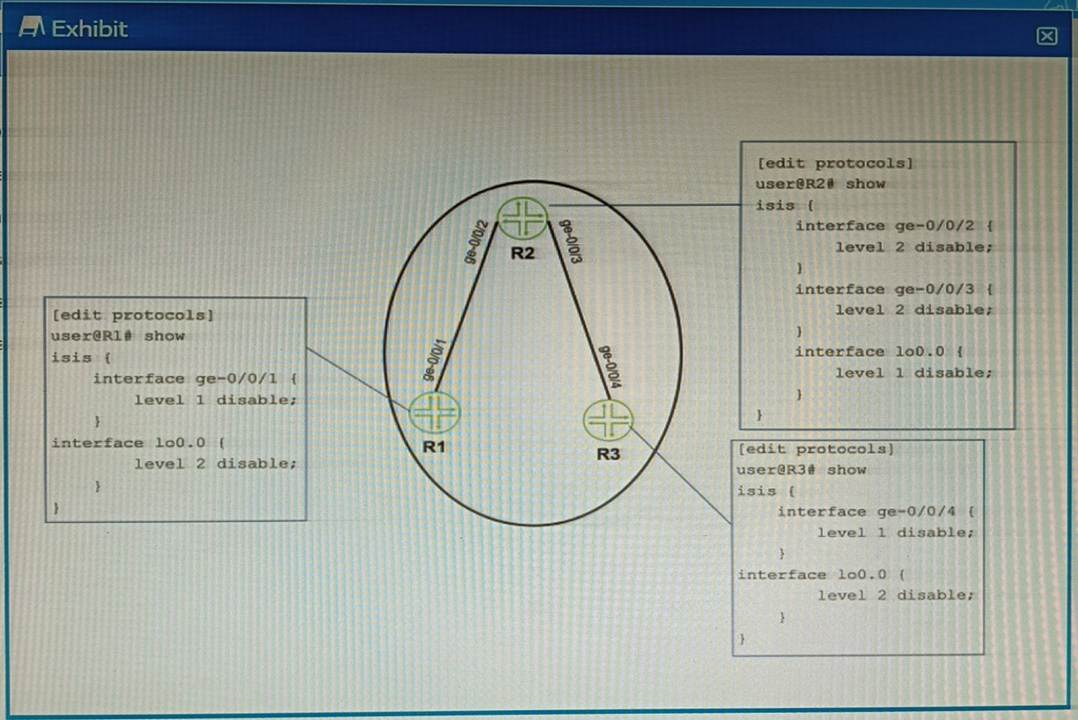
Referring to the exhibit, which two configuration changes must you apply for packets to reach from R1 to R3 using IS-IS? (Choose two.)
Correct Answer:
AD
A. On R1, enable Level 1 on the ge-0/0/1 interface. In IS-IS, both levels (Level 1 and Level 2) are enabled by default when you enable IS-IS on an interface1. Level 1 systems route within an area2. If the destination is outside an area, Level 1 systems route toward a Level 2 system2. Therefore, enabling Level 1 on the ge-0/0/1 interface on
R1 would allow packets to reach from R1 to R3.
* D. On R3 enable Level 1 on the ge-0/0/4 interface Similarly, enabling Level 1 on the ge- 0/0/4 interface on R3 would allow packets to reach from R1 to R3.
These explanations are based on the IS-IS configuration documents and learning resources available at Juniper Networks1 and Cisco34.
Which statement is correct about graceful Routing Engine switchover (GRES)?
Correct Answer:
C
The Graceful Routing Engine Switchover (GRES) feature in Junos OS enables a router with redundant Routing Engines to continue forwarding packets, even if one Routing Engine fails1. GRES preserves interface and kernel information, ensuring that traffic is not interrupted1. However, GRES does not preserve the control plane1.
To preserve routing during a switchover, GRES must be combined with either Graceful
Restart protocol extensions or Nonstop Active Routing (NSR)1. When GRES is combined with NSR, nearly 75 percent of line rate worth of traffic per Packet Forwarding Engine remains uninterrupted during GRES1. Any updates to the primary Routing Engine are replicated to the backup Routing Engine as soon as they occur1.
Therefore, when GRES is combined with NSR, routing is preserved and the new master RE does not restart rpd1.
You are attempting to configure the initial two aggregated Ethernet interfaces on a router but there are no aggregated Ethernet interfaces available.
In this scenario, which configuration will enable these interfaces on this router?
A)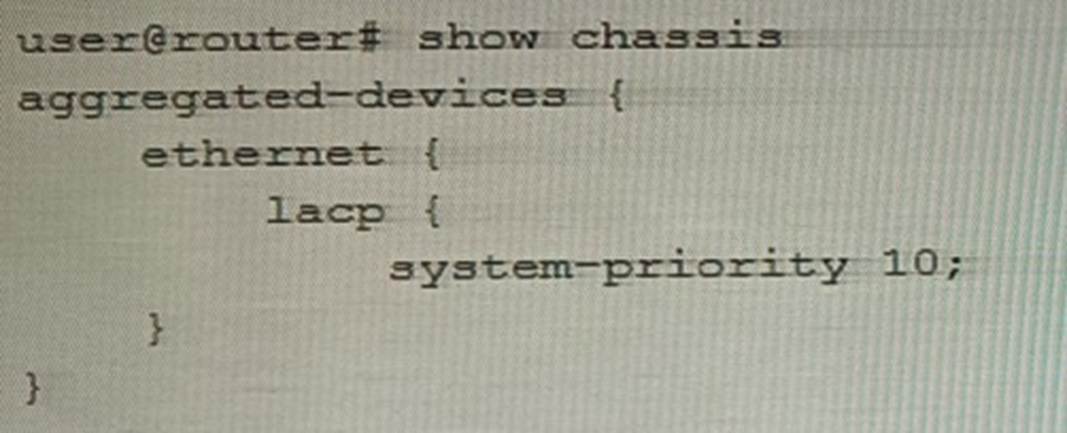
B)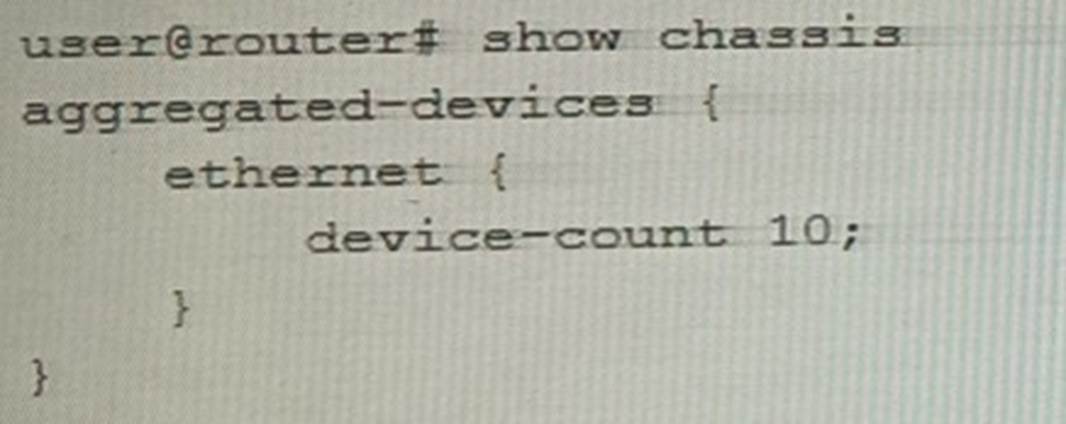
C)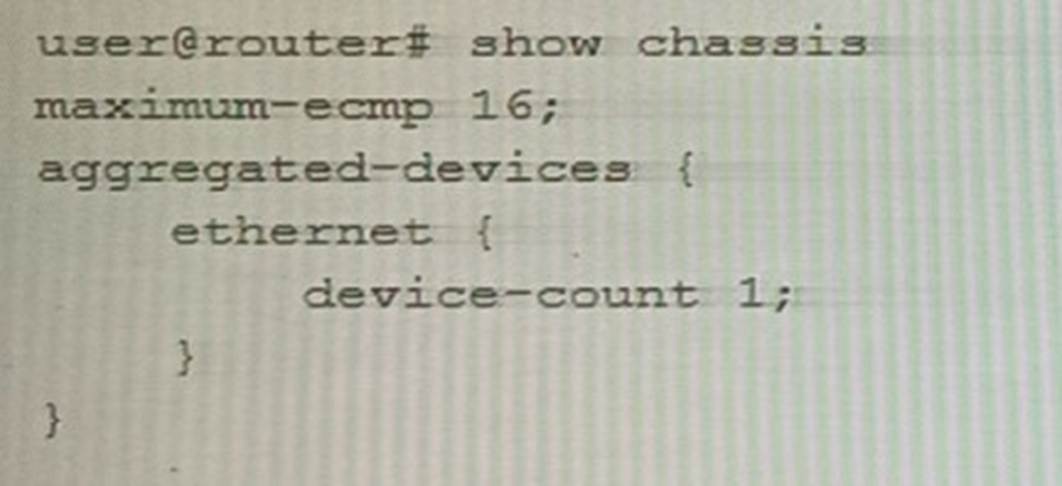
D)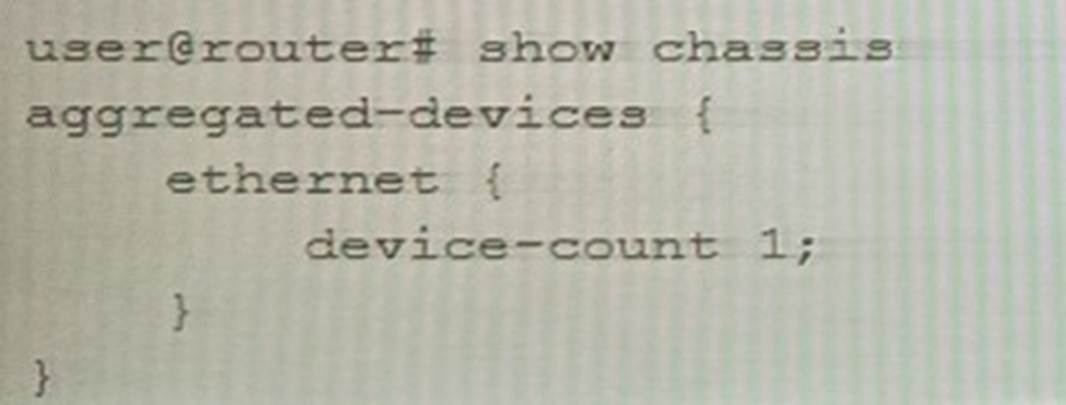
Correct Answer:
C
The correct answer to your question is C. Option C. Here is why:
✑ Option C shows the configuration of the chassis statement, which defines the properties of the router chassis, such as the number of aggregated Ethernet interfaces, the number of FPCs, and the number of PICs1.
✑ To enable aggregated Ethernet interfaces on a router, you need to specify the aggregated-devices statement under the chassis statement and set
the ethernet parameter to the desired number of interfaces2. For example, to enable two aggregated Ethernet interfaces, you can use the following configuration:
chassis { aggregated-devices { ethernet { device-count 2; } } }
✑ Option C shows this configuration with the device-count set to 2, which will enable two aggregated Ethernet interfaces on the router. The other options do not show this configuration and will not enable any aggregated Ethernet interfaces on the router.
✑ Therefore, option C is the correct answer to your question.
After receiving a BGP route, which two conditions are verified by the receiving router to ensure that the received route is valid? (Choose two)
Correct Answer:
BC
✑ B is correct because the loops do not exist is one of the conditions that are verified by the receiving router to ensure that the received BGP route is valid. A loop in BGP means that a route has been advertised by the same AS more than once, which can cause routing instability and inefficiency1. To prevent loops, BGP uses the AS-path attribute, which lists the AS numbers that a route has traversed from the origin to the destination2. The receiving router checks the AS-path attribute of the received route and discards it if it finds its own AS number in the list2. This way, BGP avoids accepting routes that contain loops.
✑ C is correct because the next hop is reachable is one of the conditions that are verified by the receiving router to ensure that the received BGP route is valid. The next hop is the IP address of the next router that is used to forward packets to the destination network3. The receiving router checks the next hop attribute of the received route and verifies that it has a valid route to reach it3. If the next hop is not reachable, the received route is not usable and is rejected by the receiving router3. This way, BGP ensures that only feasible routes are accepted.