
Which three protocols support BFD? (Choose three.)
Correct Answer:
BCD
BFD is a protocol that can be used to quickly detect failures in the forwarding path between two adjacent routers or switches. BFD can be integrated with various routing protocols and link aggregation protocols to provide faster convergence and fault recovery. According to the Juniper Networks documentation, the following protocols support BFD on Junos OS devices1:
✑ BGP: BFD can be used to monitor the connectivity between BGP peers and trigger
a session reset if a failure is detected. BFD can be configured for both internal and external BGP sessions, as well as for IPv4 and IPv6 address families2.
✑ OSPF: BFD can be used to monitor the connectivity between OSPF neighbors and
trigger a state change if a failure is detected. BFD can be configured for both OSPFv2 and OSPFv3 protocols, as well as for point-to-point and broadcast network types3.
✑ LACP: BFD can be used to monitor the connectivity between LACP members and
trigger a link state change if a failure is detected. BFD can be configured for both active and passive LACP modes, as well as for static and dynamic LAGs4.
Other protocols that support BFD on Junos OS devices are:
✑ IS-IS: BFD can be used to monitor the connectivity between IS-IS neighbors and trigger a state change if a failure is detected. BFD can be configured for both level 1 and level 2 IS-IS adjacencies, as well as for point-to-point and broadcast network types.
✑ RIP: BFD can be used to monitor the connectivity between RIP neighbors and trigger a route update if a failure is detected. BFD can be configured for both RIP version 1 and version 2 protocols, as well as for IPv4 and IPv6 address families.
✑ VRRP: BFD can be used to monitor the connectivity between VRRP routers and trigger a priority change if a failure is detected. BFD can be configured for both VRRP version 2 and version 3 protocols, as well as for IPv4 and IPv6 address families.
The protocols that do not support BFD on Junos OS devices are:
✑ RSTP: RSTP is a spanning tree protocol that provides loop prevention and rapid convergence in layer 2 networks. RSTP does not use BFD to detect link failures, but relies on its own hello mechanism that sends BPDU packets every 2 seconds by default.
✑ FTP: FTP is an application layer protocol that is used to transfer files between hosts over a TCP connection. FTP does not use BFD to detect connection failures, but relies on TCP??s own retransmission and timeout mechanisms.
References:
1: [Configuring Bidirectional Forwarding Detection] 2: [Configuring Bidirectional Forwarding Detection for BGP] 3: [Configuring Bidirectional Forwarding Detection for OSPF] 4: [Configuring Bidirectional Forwarding Detection for Link Aggregation Control Protocol] : [Configuring Bidirectional Forwarding Detection for IS-IS] : [Configuring Bidirectional Forwarding Detection for RIP] : [Configuring Bidirectional Forwarding Detection for VRRP] : [Understanding Rapid Spanning Tree Protocol] : [Understanding FTP]
Two routers share the same highest priority and start time.
Correct Answer:
B
✑ According to the OSPF protocol, the designated router (DR) is the router that acts as the focal point for exchanging routing information on a multi-access network segment, such as a LAN1. The DR election process is based on the following criteria, in order of precedence1:
✑ In your scenario, two routers share the same highest priority and start time. This means that they have equal chances of becoming the DR based on the first and third criteria. Therefore, the second criterion will be used to break the tie, which is the router ID. The router with the highest router ID will become the DR, and the other router will become the backup designated router (BDR), which is ready to take over the role of DR if it fails1.
Exhibit.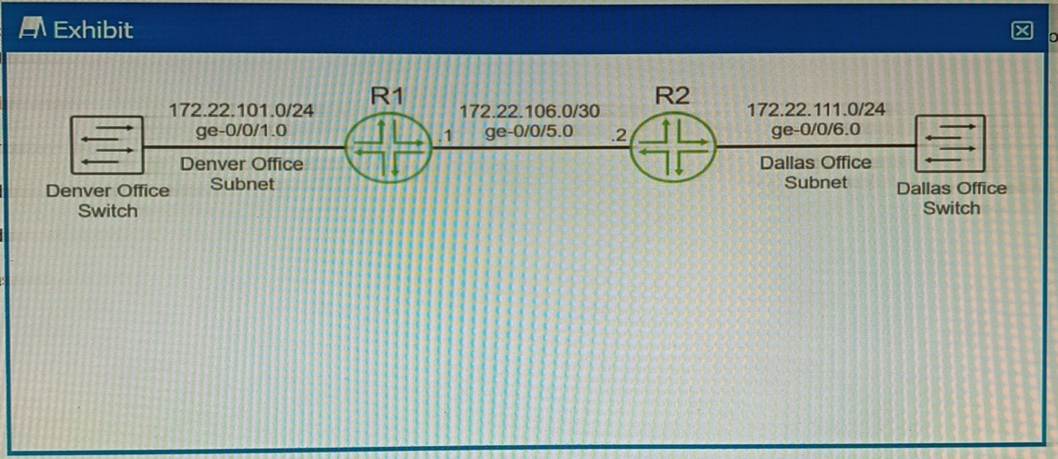
You are using OSPF to advertise the subnets that are used by the Denver and Dallas offices. The routers that are directly connected to the Dallas and Denver subnets are not advertising the connected subnets.
Referring to the exhibit, which two statements are correct? (Choose two.)
Correct Answer:
CD
The routers that are directly connected to the Dallas and Denver subnets are
not advertising the connected subnets. This can be resolved by redistributing the connected subnets into OSPF1.
Option C suggests to configure and apply a routing policy that redistributes the connected Dallas and Denver subnets. This is correct because redistribution allows routes from one routing protocol to be communicated to another, and in this case, it allows the connected subnets to be advertised through OSPF1.
Option D suggests enabling the passive option on the OSPF interfaces that are connected to the Dallas and Denver subnets. This is also correct because in OSPF, a passive interface is an interface that belongs to the OSPF router, but does not send OSPF Hello packets1. It??s typically used on an interface that you don??t want to use for OSPF adjacencies, but you still want to advertise its IP address1. Therefore, enabling passive interface can help in advertising the Dallas and Denver subnets.
Which statement about aggregate routes is correct?
Correct Answer:
D
Aggregate routes are used for advertising summarized network prefixes12. They help minimize the number of routing tables in an IP network by consolidating selected multiple routes into a single route advertisement1. This approach is in contrast to non-aggregation routing, in which every routing table contains a unique entry for each route1.
Therefore, option D is correct. Options A, B, and C are not correct because:
✑ Aggregate routes can be used with both static routing and dynamic routing protocols1.
✑ Aggregate routes are not automatically generated for all of the subnets in a routing table. They need to be manually configured1.
✑ Aggregate routes are not always preferred over more specific routes. The route selection process in Junos OS considers several factors, including route preference and metric, before determining the active route1.
Which two statements about BGP facilitate the prevention of routing loops between two autonomous systems? (Choose two.)
Correct Answer:
AC
BGP (Border Gateway Protocol) is a protocol designed to exchange routing and reachability information among autonomous systems (AS) on the internet1.
✑ Option A is correct. When an EBGP router advertises routes to its neighbors, it appends its AS number to the AS_PATH attribute1. This is a key mechanism in BGP to prevent routing loops1.
✑ Option C is correct. BGP has a built-in loop prevention mechanism whereby if a BGP router detects its own AS in the AS_PATH attribute, it will drop the prefix and will not continue to advertise it2. This helps to prevent routing loops2.
✑ Option B is incorrect. EBGP routers do not accept routes that contain their own AS number in the AS_PATH2. Instead, they drop such routes as part of the loop prevention mechanism2.
✑ Option D is incorrect. While it??s true that EBGP routers append their AS number
when advertising routes, they do not prepend their AS number1. The term ??prepend?? in BGP usually refers to a technique used to influence path selection by artificially lengthening the AS_PATH3.