
An administrator wants to search a file named myFile and look for all occurrences of strings containingat least five characters, wherecharacters two and five are i, butcharacter three is not b. Which of the following commands should the administrator execute to get the intended result?
Correct Answer:
D
Pattern matching using regular expressions is a key troubleshooting and text-processing skill covered in CompTIA Linux+ V8. The grep command, combined with regular expressions, allows administrators to search for complex string patterns within files.
The requirement specifies:
The string must containat least five characters
Character 2must be i
Character 3mustnotbe b
Character 5must be i
To meet these conditions, the correct regular expression structure is:
. ?? any character (position 1)
i ?? literal i (position 2)
[^b] ?? any character except b (position 3)
. ?? any character (position 4)
i ?? literal i (position 5)
This results in the expression:
i[^b].i
OptionD, grep .i[^b].i myFile, correctly implements this logic. It ensures positional matching and excludes unwanted characters using a negated character class ([^b]), which is explicitly covered in Linux+ V8 regular expression objectives.
The other options contain invalid or malformed regular expressions and do not meet the positional or exclusion requirements. Linux+ V8 emphasizes understanding anchors, character classes, and position-based matching when troubleshooting log files or configuration data.
Therefore, the correct answer isD.
While hardening a system, an administrator runs a port scan with Nmap, which returned the following output: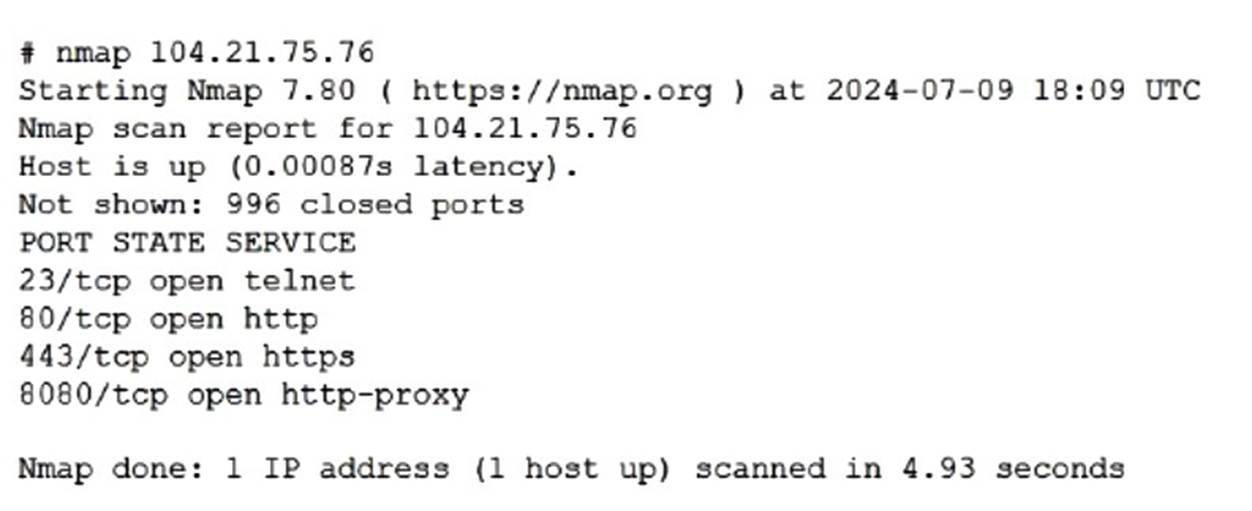
Which of the following is the best way to address this security issue?
Correct Answer:
D
This scenario falls under theSecuritydomain of the CompTIA Linux+ V8 objectives and focuses on system hardening and service minimization. The Nmap scan output reveals thatport 23 (Telnet)is open on the system, which represents a significant security risk.
Telnet is an insecure, legacy protocol that transmits authentication credentials and session data inplaintext, making it vulnerable to interception through packet sniffing or man-in-the-middle attacks. Linux+ V8 documentation explicitly emphasizes the principle ofleast functionality, which states that unnecessary or insecure services should be disabled and removed entirely rather than merely restricted.
OptionD, disabling and removing the Telnet service on the server, is the best and most secure solution. This action eliminates the vulnerable service completely, ensuring that it cannot be exploited internally or externally. In secure Linux environments, Telnet should be replaced withSSH, which provides encrypted communication and strong authentication mechanisms.
OptionA, blocking port 23 with a firewall, reduces exposure but does not eliminate the underlying risk. If the firewall rules are misconfigured or bypassed, the Telnet service would still be available. Linux+ V8 best practices recommend removing insecure services rather than relying solely on perimeter controls.
OptionBis unrelated, as changing passwords does not address the risk of plaintext credential transmission. OptionCis incorrect because closing ports at the network switch level is not an appropriate or scalable solution for host-level service hardening and does not address internal access risks.
Linux+ V8 documentation consistently highlights service auditing, port scanning, and removal of insecure protocols as essential system hardening steps. Therefore, the most effective and secure remediation is to disable and remove the Telnet service.
Which of the following is the main reason for setting up password expiry policies?
Correct Answer:
B
Password management is a core topic in the Security domain of CompTIA Linux+ V8. Password expiry policies are implemented to reduce the risk associated with long-lived credentials.
The primary reason for enforcing password expiration is to mitigate the risk of exposed or compromised passwords. If a password is leaked through phishing, malware, keylogging, or data breaches, limiting its lifespan reduces the window of opportunity for attackers to exploit it. Requiring periodic password changes ensures that compromised credentials eventually become invalid.
Option B correctly captures this security objective. Linux+ V8 documentation emphasizes minimizing credential exposure as a key principle of access control.
The other options are secondary or incorrect. Avoiding password reuse and increasing complexity are addressed through password history and complexity policies, not expiration alone. Password expiry does not force passwordless authentication, making option C incorrect.
Therefore, the correct answer is B. To mitigate the use of exposed passwords.
A Linux administrator updates the DNS record for the company using:
cat /etc/bind/db.abc.com
The revised partial zone file is as follows:
ns1 IN A 192.168.40.251
ns2 IN A 192.168.40.252
www IN A 192.168.30.30
When the administrator attempts to resolve www.abc.com to its IP address, the domain name still points to its old IP mapping:
nslookup www.abc.com
Server: 192.168.40.251
Address: 192.168.40.251#53
Non-authoritative answer
Name: www.abc.com
Address: 199.168.20.81
Which of the following should the administrator execute to retrieve the updated IP mapping?
Correct Answer:
D
This scenario represents a classic DNS troubleshooting situation covered in the Troubleshooting domain of the CompTIA Linux+ V8 objectives. Although the DNS zone file has been updated correctly on the BIND server, the system continues to resolve the domain name to an outdated IP address. This behavior strongly indicates DNS caching rather than a configuration error in the zone file itself.
Modern Linux systems that use systemd-resolved cache DNS responses locally to improve performance and reduce external queries. Even after a DNS record is updated on the authoritative server, cached results may persist until the cache expires or is manually cleared. The nslookup output showing a non-authoritative answer further confirms that the response is being served from a cache rather than directly from the updated zone data.
The correct solution is to flush the local DNS cache so the system can retrieve the updated record from the DNS server. The command resolvectl flush-caches clears all cached DNS entries maintained by systemd- resolved, forcing fresh queries to authoritative name servers. This aligns directly with Linux+ V8 documentation for resolving name resolution inconsistencies caused by stale cache entries.
The other options are incorrect for the following reasons. systemd-resolve query www.abc.com performs a DNS lookup but does not clear cached entries. systemd-resolve status only displays resolver configuration and statistics. service nslcd reload reloads the Name Service LDAP daemon and is unrelated to DNS resolution or caching.
Linux+ V8 emphasizes identifying whether issues originate from services, configuration, or cached data. In this case, flushing the DNS cache is the correct and least disruptive corrective action.
Therefore, the correct answer is D. resolvectl flush-caches.