
Which is a requirement to enable SNMP v2c on a managed FortiSwitch?
Correct Answer:
D
To enable SNMP v2c on a managed FortiSwitch, the essential requirement involves configuring the SNMP agent and community strings:
Configure SNMP Agent and Communities (D):
Understanding Other Options:
References:For detailed instructions on configuring SNMP on FortiSwitch, you can refer to the SNMP configuration section in the FortiSwitch administration guide available on:Fortinet Product Documentation
Which statement about 802.1X security profiles using MAC-based authentication mode is true?
Correct Answer:
D
In the context of 802.1X security profiles using MAC-based authentication mode, the following statement is true: FortiSwitch must communicate with the RADIUS server to authenticate devices (D): Authentication Process:MAC-based authentication involves the switch forwarding the MAC address of a connecting device to a RADIUS server. The RADIUS server then checks this MAC address against a database of allowed addresses to determine whether the device should be granted access to the network.
 RADIUS Server Role:The use of a RADIUS server is crucial because it centralizes the authentication process and allows for scalable management of connected devices across the network.
References:For comprehensive insights into 802.1X and MAC-based authentication on FortiSwitch, including the role of RADIUS servers, consult security configuration resources or the FortiSwitch security manual available at:Fortinet Product Documentation
What type of multimode transceiver can be used to split a 40G port?
Correct Answer:
A
QSFP+ transceiver (A): The QSFP+ (Quad Small Form-factor Pluggable Plus) transceiver is designed to handle 40G data rates and can be used to split a 40G port into multiple 10G connections. This type of transceiver supports such configurations, making it suitable for high-density applications where multiple 10G connections are derived from a single 40G port, thereby maximizing the utilization of the port and the fiber infrastructure.
Which QoS mechanism maps packets with specific CoS or DSCP markings to an egress queue?
Correct Answer:
A
The QoS mechanism that directly maps packets with specific Class of Service (CoS) or Differentiated Services
Code Point (DSCP) markings to an egress queue is:
Queuing for Egress Traffic (A):
Functionality:This QoS feature involves assigning outgoing packets to different queues based on their priority level, which is indicated by their CoS or DSCP markings. The queues then manage the packets based on their priority, ensuring that higher-priority traffic gets transmitted sooner or with more bandwidth.
References: For a deeper understanding of how egress queuing works and how it utilizes CoS and DSCP
markings in FortiSwitch, detailed QoS configuration guides are available on:Fortinet Technical Documentation
Exhibit.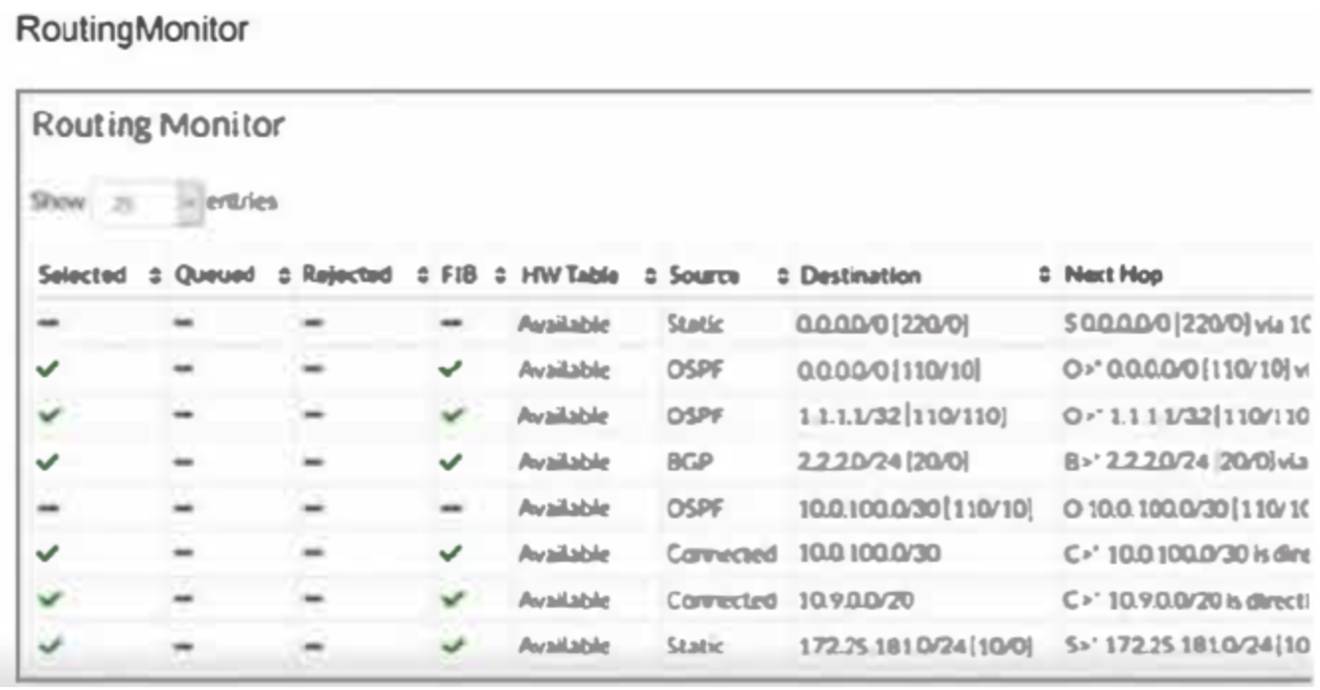
Two routes are not installed in the forwarding information base (FIB) as shown in the exnibit. Which two statements about these two route entries are true? (Choose two.)
Correct Answer:
AB
From the exhibit and the details given about the routes not installed in the FIB:
These two routes have a higher administrative distance value available to the destination networks (Option A): Administrative distance is a measure used by routers to select the best path when there are two or more different routes to the same destination from two different routing protocols. A higher administrative distance means that the route is considered less trustworthy, thus not selected for the FIB unless the more preferred routes fail.
These two routes will become primary, if the best routes are removed (Option B): In routing, if the currently installed routes (which are considered the best due to reasons like lower administrative distance) are removed or become unavailable, the next best routes based on administrative distance will be used. This behavior ensures redundancy and maintains network connectivity in diverse scenarios.
References:
This approach is aligned with standard routing protocol behavior as documented in networking protocols and Fortinet??s routing mechanisms which prioritize routes based on administrative distance and other metrics to maintain efficient and reliable network routing.