
You have deployed a new site as shown in the exhibit. Hosts in the 10.10.10.0/24 network
must access the DB1 server. The DB1 server must also have internet access the DB1 server encrypted.
Which two configuration statements will be required as part of the configuration on SRX1 to satisfy this requirement? (Choose two)
Correct Answer:
AD
A customer wants to be able to initiate a return connection to an internal host from a specific
Server.
Which NAT feature would you use in this scenario?
Correct Answer:
A
A company has acquired a new branch office that has the same address space as one of its local networks, 192.168.100.0/24. The offices need to communicate with each other.
Which two NAT configurations will satisfy this requirement? (Choose two.)
Correct Answer:
BC
* 1. Static NAT Configuration at Office A (Option B):
✑ Configuration:
[edit security nat static]
user@OfficeA# show rule-set From-Office-B { from interface ge-0/0/0.0;
rule 1 { match {
destination-address 192.168.200.0/24;
}
then { static-nat {
prefix { 192.168.100.0/24; }
}
}
}
}
✑ Explanation:
Reference:
Juniper Networks Documentation: "Configuring Static NAT"
* 2. Static NAT Configuration at Office B (Option C): Configuration:
[edit security nat static]
user@OfficeB# show rule-set From-Office-A { from interface ge-0/0/0.0;
rule 1 { match {
destination-address 192.168.210.0/24;
}
then { static-nat {
prefix { 192.168.100.0/24; }
}
}
}
}
* Explanation:
from interface ge-0/0/0.0;: Specifies the interface through which the traffic is received.
Matching Traffic:
destination-address 192.168.210.0/24;: Matches packets destined for 192.168.210.0/24. Action:
static-nat { prefix { 192.168.100.0/24; } }: Translates the destination address to 192.168.100.0/24.
Result:
Office A sends packets to 192.168.210.0/24, which are translated to 192.168.100.0/24
upon arrival at Office B.
Reference:
Juniper Networks Documentation: "Configuring Static NAT"
Why Options A and D are Incorrect:
Option A and Option D use Source NAT, which is typically used for translating the source IP address of outgoing traffic.
Source NAT with interface-based translation may not resolve overlapping IP issues effectively because it doesn't provide a one-to-one mapping of the overlapping addresses.
In scenarios with overlapping networks, Static NAT is preferred as it allows for consistent and predictable address translation, essential for two-way communication.
Key Juniper Concepts: Static NAT:
Provides a one-to-one mapping between local and global addresses. Useful for scenarios where bidirectional communication is required. Reference: Juniper Networks Day One Book "Advanced NAT Concepts" Source NAT:
Typically used for translating private IP addresses to public IP addresses for outbound traffic.
Interface-based Source NAT translates the source IP to the IP address of the egress interface.
Not ideal for resolving overlapping IP spaces in bidirectional communication.
Additional References:
Juniper TechLibrary:
"Understanding NAT in SRX Series Devices" "Configuring NAT for Overlapping Networks" Juniper Forums and Knowledge Base Articles:
Discussions on resolving overlapping IP address spaces using Static NAT.
Conclusion:
By implementing Static NAT configurations as shown in Options B and C, both offices can effectively communicate despite having overlapping IP address spaces. Static NAT ensures that IP addresses are uniquely translated, avoiding conflicts and enabling seamless connectivity between the two networks.
Referring to the exhibit, you are assigned the tenantSYS1 user credentials on an SRX series device.
In this scenario, which two statements are correct? (Choose two.)
Correct Answer:
BC
Referring to the exhibit,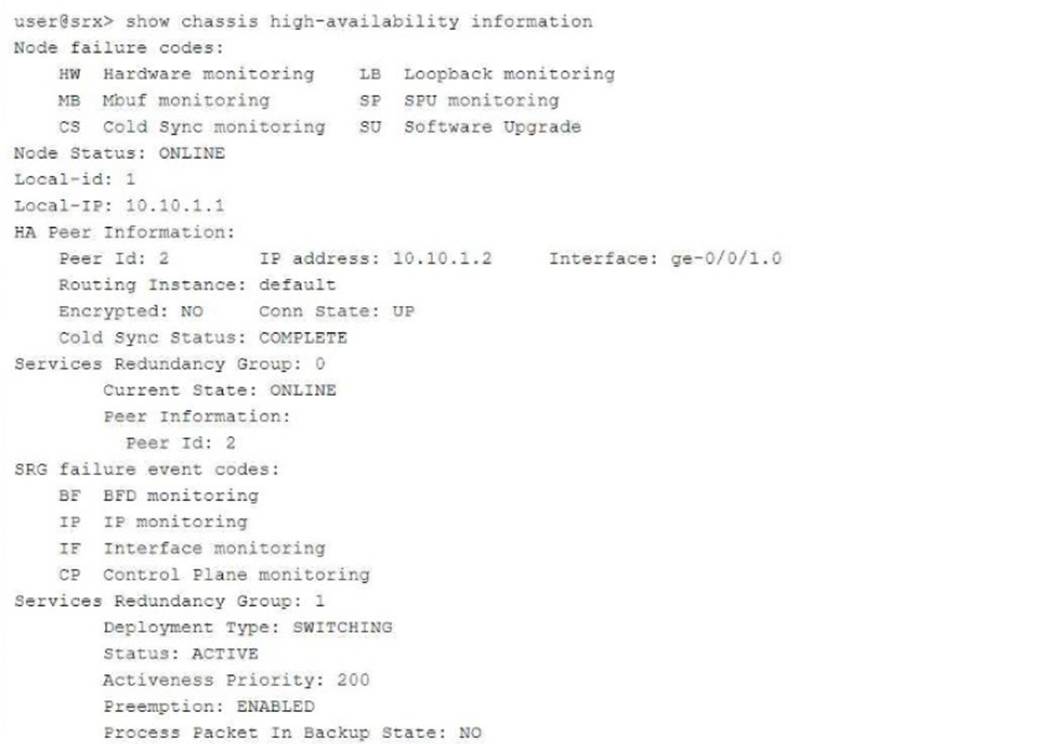
which three statements about the multinode HA environment are true? (Choose three.)
Correct Answer:
ACD
Referring to the exhibit for a multinode HA environment, we can conclude the following about the HA setup:
✑ Two Services Redundancy Groups (Correct: Option A):The output shows the
status of SRG 0 and SRG 1, confirming that there are two services redundancy groups in the HA configuration.
✑ Node 1 Hosting SRG 1 (Correct: Option C):The exhibit indicates that Node 1 is
currently active for SRG 1. According to the configuration, Node 1 will continue to host SRG 1 unless it becomes unavailable.
✑ Session State Synchronization (Correct: Option D):In this HA setup, session state
synchronization is enabled between the two nodes. This ensures that sessions remain active and seamless failover can occur if one node fails.
Juniper References:
✑ Juniper HA Documentation: Provides details on multinode HA setups, SRG configurations, and session synchronization.
==========