
What is the expected output of the following code?
Correct Answer:
B
The code snippet that you have sent is using the slicing operation to get parts of a string and concatenate them together. The code is as follows:
pizza = ??pizza?? pasta = ??pasta?? folpetti = ??folpetti?? print(pizza[0] + pasta[0] + folpetti[0])
The code starts with assigning the strings ??pizza??, ??pasta??, and ??folpetti?? to the variables pizza, pasta, and folpetti respectively. Then, it uses the print function to display the result of concatenating the first characters of each string. The first character of a string can be accessed by using the index 0 inside square brackets. For example, pizza[0] returns ??p??. The concatenation operation is used to join two or more strings together by using the + operator. For example, ??a?? + ??b?? returns ??ab??. The code prints the result of pizza[0] + pasta[0] + folpetti[0], which is ??p?? + ??p?? + ??f??, which is ??ppt??.
The expected output of the code is ppt, because the code prints the first characters of each string. Therefore, the correct answer is B. ppt.
Reference: Python String Slicing - W3SchoolsPython String Concatenation - W3Schools
Python Is an example of which programming language category?
Correct Answer:
A
Python is an interpreted programming language, which means that the source code is translated into executable code by an interpreter at runtime, rather than by a compiler beforehand. Interpreted languages are more flexible and portable than compiled languages, but they are also slower and less efficient. Assembly and machine languages are low-level languages that are directly executed by the hardware, while compiled languages are high-level languages that are translated into machine code by a compiler before execution.
Reference: [Python Institute - Entry-Level Python Programmer Certification]
Which of the following functions can be invoked with two arguments?
A)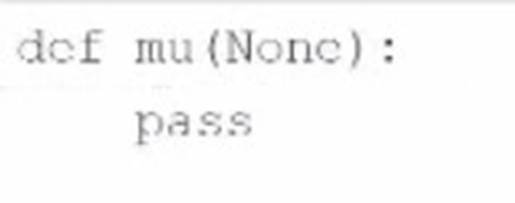
B)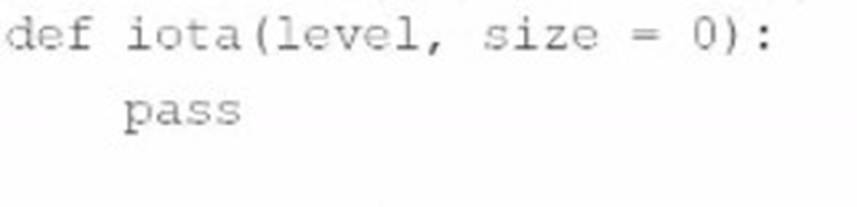
C)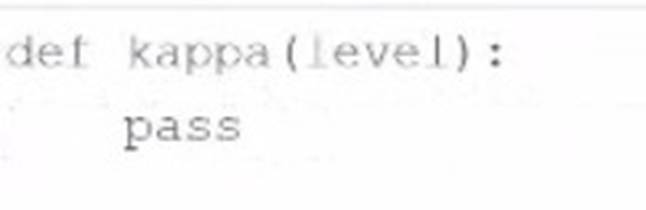
D)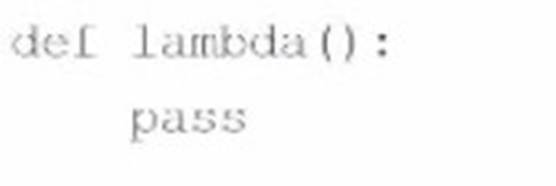
Correct Answer:
B
The code snippets that you have sent are defining four different functions in Python. A function is a block of code that performs a specific task and can be reused in the program. A function can take zero or more arguments, which are values that are passed to the function when it is called. A function can also return a value or None, which is the default return value in Python.
To define a function in Python, you use the def keyword, followed by the name of the function and parentheses. Inside the parentheses, you can specify the names of the parameters that the function will accept. After the parentheses, you use a colon and then indent the code block that contains the statements of the function. For example:
def function_name(parameter1, parameter2): # statements of the function return value To call a function in Python, you use the name of the function followed by parentheses.
Inside the parentheses, you can pass the values for the arguments that the function expects. The number and order of the arguments must match the number and order of the parameters in the function definition, unless you use keyword arguments or default values. For example:
function_name(argument1, argument2)
The code snippets that you have sent are as follows:
A) def my_function(): print(??Hello??)
B) def my_function(a, b): return a + b
C) def my_function(a, b, c): return a * b * c
D) def my_function(a, b=0): return a - b
The question is asking which of these functions can be invoked with two arguments. This means that the function must have two parameters in its definition, or one parameter with a default value and one without. The default value is a value that is assigned to a parameter if no argument is given for it when the function is called. For example, in option D, the parameter b has a default value of 0, so the function can be called with one or two arguments.
The only option that meets this criterion is option B. The function in option B has two parameters, a and b, and returns the sum of them. This function can be invoked with two arguments, such as my_function(2, 3), which will return 5.
The other options cannot be invoked with two arguments. Option A has no parameters, so it can only be called with no arguments, such as my_function(), which will print ??Hello??. Option C has three parameters, a, b, and c, and returns the product of them. This function can only be called with three arguments, such as my_function(2, 3, 4), which will return 24. Option D has one parameter with a default value, b, and one without, a, and returns the difference of them. This function can be called with one or two arguments, such as my_function(2) or my_function(2, 3), which will return 2 or -1, respectively.
Therefore, the correct answer is B. Option B.
DRAG DROP
Insert the code boxes in the correct positions in order to build a line of code which asks the user for a float value and assigns it to the mass variable.
(Note: some code boxes will not be used.)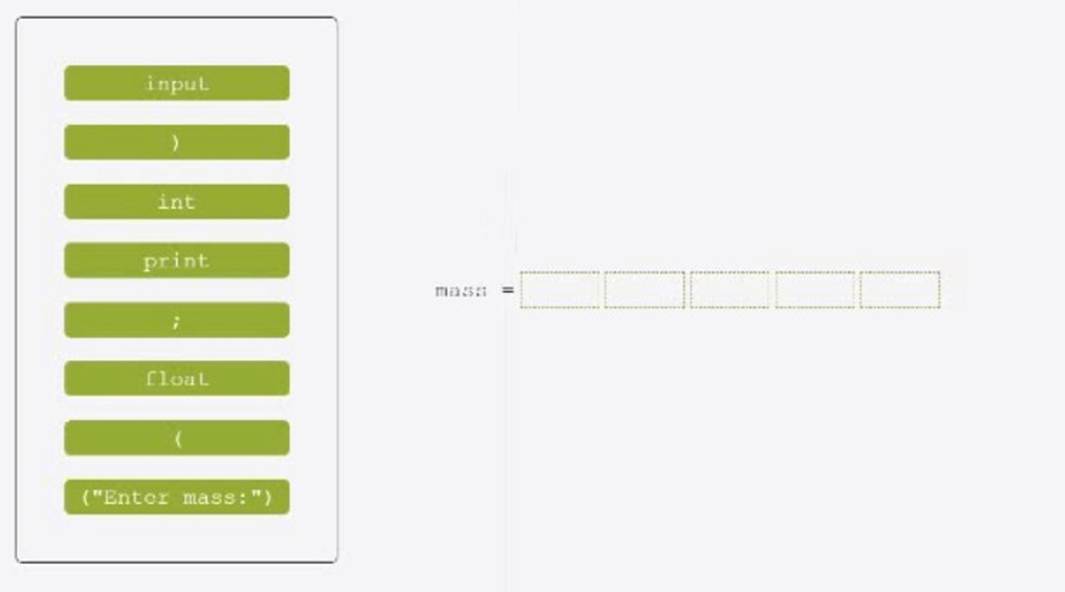
Solution: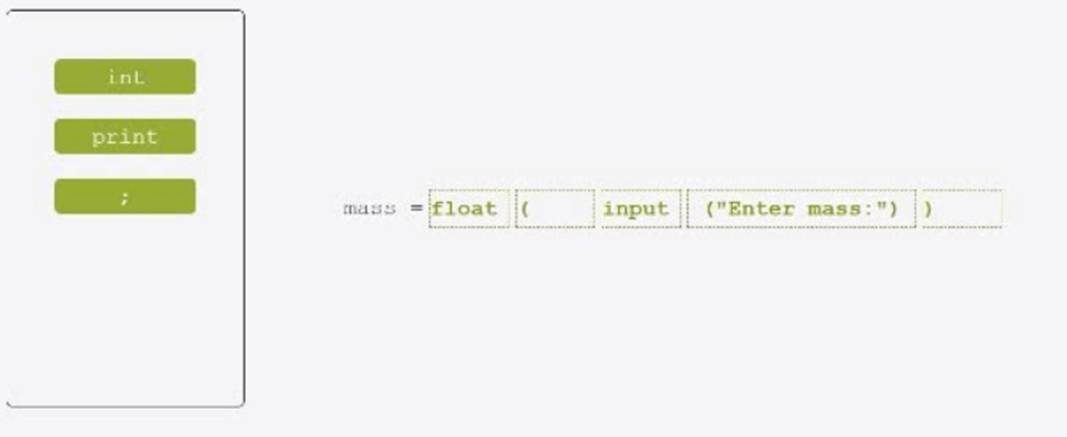
One possible way to insert the code boxes in the correct positions in order to build a line of code that asks the user for a float value and assigns it to the mass variable is:
mass = float(input("Enter the mass: "))
This line of code uses the input function to prompt the user for a string value, and then uses the float function to convert that string value into a floating-point number. The result is then assigned to the variable mass.
You can find more information about the input and float functions in Python in the following references:
✑ [Python input() Function]
✑ [Python float() Function]
Does this meet the goal?
Correct Answer:
A