
An architect is designing a new VMware Cloud Foundation (VCF) solution. During the discovery workshops, the customer explained that the solution will initially be used to host a single business application and some internal management tooling. The customer provided the following background information:
The business application consists of two virtual machines.
The business application is sensitive to changes in its storage I/O.
The business application must be available during the company??s business hours of 9 AM - 5 PM on weekdays.
The architect has made the following design decisions in response to the customer??s requirements and the additional information provided during discovery:
The solution will use the VCF consolidated architecture model. A single cluster will be created, consisting of six ESXi hosts.
Which design decision should the architect include in the design to mitigate the risk of impacting the business application?
Correct Answer:
C
The VCF 5.2 design must ensure the business application (two VMs) remains available during business hours (9 AM - 5 PM weekdays) and is protected from storage I/O disruptions in a consolidated architecture with a single six-host cluster using vSAN. The goal is to mitigate risks to the application??s performance and availability. Let??s evaluate each option:
Option A: Use resource pools to apply CPU and memory reservations on the business application virtual machinesResource pools with reservations ensure CPU and memory availability, which could help performance. However, the application??s sensitivity is tostorage I/O, not CPU/memory, and the availability requirement (business hours) isn??t directly addressed by reservations. While useful, this doesn??t fully mitigate the primary risks identified, making it less optimal.
Option B: Implement FTT=6 for the business application virtual machinesThis is incorrect and infeasible. In vSAN, Failures to Tolerate (FTT) defines the number of host or disk failures a storage object can withstand, with a maximum FTT dependent on cluster size. FTT=6 requires at least 13 hosts (2n+1 where n=6), but the cluster has only six hosts, supporting a maximum FTT=2 (RAID-5/6). Even if feasible, FTT addresses data redundancy, not runtime availability or I/O sensitivity during business hours, making this irrelevant to the stated risks.
Option C: Perform ESXi host maintenance activities outside of the stated business hoursThis is the correct answer. In a vSAN-based VCF cluster, ESXi host maintenance (e.g., patching, reboots) triggers data resyncs and VM migrations (via vMotion), which can impact storage I/O performance and potentially cause brief disruptions. The application??s sensitivity to storage I/O and its availability requirement (9 AM - 5 PM weekdays) mean maintenance during business hours poses a risk. Scheduling maintenance outside these hours (e.g., nights or weekends) mitigates this by ensuring uninterrupted I/O performance and availability during critical times, directly addressing the customer??s needs.
Option D: Replace the vSAN shared storage exclusively with an All-Flash Fibre Channel shared storage solutionThis is incorrect. While an All-Flash Fibre Channel array might offer better I/O performance, VCF??s consolidated architecture relies on vSAN as the primary storage for management and workload domains. Replacing vSAN entirely contradicts the chosen architecture and introduces unnecessarycomplexity and cost. The sensitivity to storage I/O changes doesn??t justify abandoning vSAN, especially since All- Flash vSAN could meet performance needs if properly tuned.
Option E: Use Anti-Affinity Distributed Resource Scheduler (DRS) rules on the business application virtual machinesAnti-Affinity DRS rules ensure the two VMs run on separate hosts, improving availability by avoiding a single host failure impacting both. While this mitigates some risk, it doesn??t address storage I/O sensitivity (a vSAN-wide concern) or guarantee availability during business hours if maintenance occurs. It??s a partial solution but less effective than scheduling maintenance outside business hours.
Conclusion:The best design decision is toperform ESXi host maintenance activities outside of the stated business hours(Option C). This directly mitigates the risk of storage I/O disruptions and ensures availability during 9 AM - 5 PM weekdays, aligning with the customer??s requirements in the VCF 5.2 consolidated architecture.
References:
VMware Cloud Foundation 5.2 Architecture and Deployment Guide (Section: Consolidated Architecture Design)
VMware vSAN 7.0U3 Planning and Deployment Guide (integrated in VCF 5.2): Maintenance Mode Considerations
VMware Cloud Foundation 5.2 Planning and Preparation Guide (Section: Availability and Performance Design)
During a requirement capture workshop, the customer expressed a plan to use Aria Operations Continuous Availability. The customer identified two datacenters that meet the network requirements to support Continuous Availability; however, they are unsure which of the following datacenters would be suitable for the Witness Node.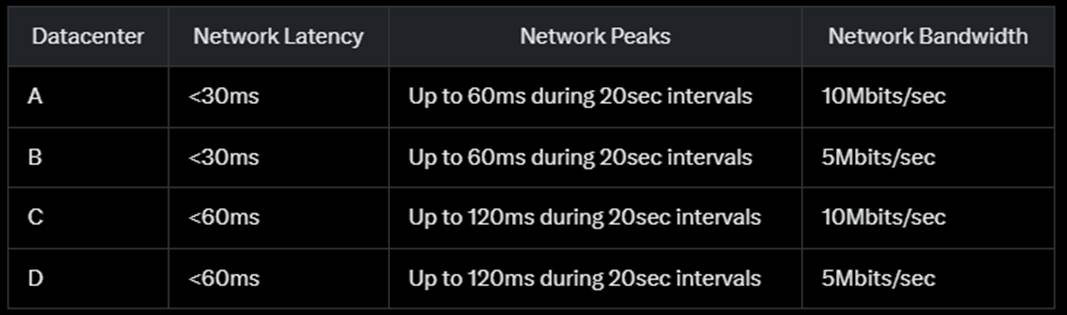
Which datacenter meets the minimum network requirements for the Witness Node?
Correct Answer:
A
VMware Aria Operations Continuous Availability (CA) is a feature in VMware Aria Operations (integrated with VMware Cloud Foundation 5.2) that provides high availability by splitting analytics nodes across two fault domains (datacenters) with a Witness Node in a third location to arbitrate in case of a split-brain scenario. The Witness Node has specific network requirements for latency and bandwidth to ensure reliable communication with the primary and replica nodes. These requirements are outlined in the VMware Aria Operations documentation, which aligns with VCF 5.2 integration.
VMware Aria Operations CA Witness Node Network Requirements: Network Latency:
The Witness Node requires a round-trip latency ofless than 100msbetween itself and both fault domains under normal conditions.
Peak latency spikes are acceptable if they are temporary and do not exceed operational thresholds, but sustained latency above 100ms can disrupt Witness functionality. Network Bandwidth:
The minimum bandwidth requirement for the Witness Node is10Mbits/sec(10 Mbps) to support heartbeat traffic, state synchronization, and arbitration duties. Lower bandwidth risks communication delays or failures.
Network Stability:
Temporary latency spikes (e.g., during 20-second intervals) are tolerable as long as the baseline latency remains within limits and bandwidth supports consistent communication. Evaluation of Each Datacenter:
Datacenter A: <30ms>Latency: Baseline latency is <30ms>Conclusion: Datacenter A fully satisfies the Witness Node requirements.
Datacenter B: <30ms>Latency: Baseline <30ms>Conclusion: Datacenter B does not meet the bandwidth requirement.
Datacenter C: <60ms>Latency: Baseline <60ms>Bandwidth: 10Mbits/sec meets the requirement.
Conclusion: Datacenter C fails due to excessive latency peaks.
Datacenter D: <60ms>Latency: Baseline <60ms>Bandwidth: 5Mbits/sec is below the required 10Mbits/sec. Conclusion: Datacenter D fails on both latency peaks and bandwidth. Conclusion:
OnlyDatacenter Ameets the minimum network requirements for the Witness Node in Aria Operations Continuous Availability. Its baseline latency (<30ms>References:
VMware Cloud Foundation 5.2 Architecture and Deployment Guide (Section: Aria Operations Integration)
VMware Aria Operations 8.10 Documentation (integrated in VCF 5.2): Continuous Availability Planning
VMware Aria Operations 8.10 Installation and Configuration Guide (Section: Network Requirements for Witness Node)
A customer has stated the following requirements for Aria Automation within their VCF implementation:
Users must have access to specific resources based on their company organization. Developers must only be able to provision to the Development environment. Production workloads can be placed on DMZ or Production clusters.
What two design decisions must be implemented to satisfy these requirements? (Choose two.)
Correct Answer:
CD
In VMware Cloud Foundation (VCF) 5.2, Aria Automation (formerly vRealize Automation) manages resource provisioning and access control. The requirements involve role-based access, environment isolation, and workload placement flexibility. Let??s analyze each option:
Option A: Separate tenants will be configured for Development and ProductionAria Automation in VCF 5.2 operates as a single-tenant application by default, integrated with SDDC Manager and vCenter. Multi-tenancy (separate tenants) is an advanced configuration typically used for service providers, not standard VCF private cloud designs. TheVMware Aria Automation Installation Guidenotes that multi-tenancy adds complexity and isn??t required for environment segregation within a single organization. Instead, projects and cloud zones handle these needs, making this unnecessary.
Option B: Users?? access to resources will be controlled by tenant membership
Tenant membership applies in multi-tenant setups, where users are assigned to distinct tenants (e.g., Dev vs. Prod). Since VCF 5.2 typically uses a single tenant, and the requirements can be met with projects (group-based access), this isn??t a must-have decision. TheVCF 5.2 Architectural Guidefavors project-based access over tenant separation for organizational control, rendering this optional.
Option C: Users?? access to resources will be controlled by project membership Projects in Aria Automation group users and define their access to resources (e.g., cloud zones, policies). To meet the first requirement (access based on company organization) and the second (developers provisioning only to Development), projects can restrict developers to a ??Dev?? project linked to a Development cloud zone, while other teams (e.g., ops) access Production/DMZ via separate projects. TheVMware Aria Automation Administration Guideconfirms projects as the primary mechanism for role-based access in VCF, making this a required decision.
Option D: Separate cloud zones will be configured for Development and Production Cloud zones in Aria Automation map to vSphere clusters or resource pools (e.g., Development, Production, DMZ clusters). To satisfy the second requirement (developers limited to Development) and the third (Production workloads on DMZ or Production clusters), separate cloud zones ensure environment isolation and placement flexibility. The VCF 5.2 Architectural Guidemandates cloud zones for workload segregation, tying them to projects for access control, making this essential.
Conclusion:
C: Project membership enforces user access per organization and restricts developers to Development, meeting the first two requirements.
D: Separate cloud zones isolate Development from Production/DMZ, enabling precise workload placement per the third requirement.These decisions align with Aria Automation??s design in VCF 5.2.References:
VMware Cloud Foundation 5.2 Architectural Guide(docs.vmware.com): Aria Automation Design and Cloud Zones.
VMware Aria Automation Administration Guide(docs.vmware.com): Projects and Access Control.
VMware Aria Automation Installation Guide(docs.vmware.com): Tenancy Options in VCF.
An architect has been tasked with reviewing a VMware Cloud Foundation design document. Observe the following requirements:
REQ01: The solution must support the private cloud cybersecurity industry and local standards and controls.
REQ02: The solution must ensure that the cloud services are transitioned to operation teams.
REQ03: The solution must provide a self-service portal.
REQ04: The solution must provide the ability to consume storage based on policies. REQ05: The solution should provide the ability to extend networks between different
availability zones.
Observe the following design decisions:
DD01: There will be a clustered deployment of Aria Automation.
DD02: There will be an integration between Aria Automation and multiple geo-located vCenter Servers.
Based on the information provided, which two requirements satisfy the stated design decisions? (Choose two.)
Correct Answer:
CE
In VMware Cloud Foundation (VCF) 5.2, VMware Aria Automation (formerly vRealize Automation) enhances the platform by providing self-service, automation, and multi-site management capabilities. The architect must determine which requirements (REQ01-REQ05) are directly satisfied by the design decisions (DD01 and DD02). Let??s evaluate each requirement against the decisions:
Design Decisions:
DD01: Clustered deployment of Aria Automation
A clustered deployment ensures high availability and scalability of Aria Automation, supporting multiple users and workloads with resilience.
DD02: Integration between Aria Automation and multiple geo-located vCenter Servers
This enables centralized management of distributed vSphere environments (e.g., across availability zones or regions), facilitating network and resource orchestration. Evaluation of Requirements:
Option A: REQ01 - The solution must support the private cloud cybersecurity industry and local standards and controls
This requirement focuses on cybersecurity and compliance (e.g., encryption, access controls, auditing). While Aria Automation supports role-based access control (RBAC) and integrates with secure VCF components, neither DD01 nor DD02 directly addresses cybersecurity standards or local controls. These are typically met by VCF??s baseline security features (e.g., NSX, vSphere hardening), not specifically by Aria Automation??s clustering or vCenter integration. Thus, REQ01 is not directly satisfied by the stated decisions.
Option B: REQ02 - The solution must ensure that the cloud services are transitioned to operation teams
This requirement implies operational handoff, training, or automation to enable operations teams to manage services. Aria Automation??s clustering (DD01) improves reliability, and vCenter integration (DD02) centralizes management, but neither explicitly ensures a transition process (e.g., documentation, runbooks). This is more about operational processes than the technical decisions provided, so REQ02 is not directly satisfied. Option C: REQ03 - The solution must provide a self-service portal
This is correct. Aria Automation??s primary function in VCF 5.2 is to provide a self-service portal for users to provision and manage resources (e.g., VMs, applications). A clustered deployment (DD01) ensures theportal??s availability and scalability, supporting multiple users concurrently. Integration with vCenter Servers (DD02) enhances its capability to deploy resources across sites, but DD01 alone directly satisfies REQ03 by enabling a robust self-service experience. Thus, REQ03 is satisfied.
Option D: REQ04 - The solution must provide the ability to consume storage based on policies
This requirement involves policy-driven storage management (e.g., vSAN storage policies).
Aria Automation supports storage policies via integration with vSphere/vSAN, allowing users to define storage profiles (e.g., performance, capacity). However, this capability is inherent to vSphere/vSAN integration, not uniquely tied to clustering (DD01) or geo-located vCenter integration (DD02). While Aria Automation facilitates this, the design decisions don??t specifically address storage policy consumption as a primary outcome, making REQ04 less directly satisfied compared to others.
Option E: REQ05 - The solution should provide the ability to extend networks between different availability zones
This is correct. Integrating Aria Automation with multiple geo-located vCenter Servers (DD02) enables management of distributed environments, including network extension across availability zones. In VCF 5.2, this leverages NSX-T for Layer 2 stretching (e.g., via HCX or NSX Federation), orchestrated through Aria Automation. DD02 directly supports this by connecting disparate vCenters, allowing network policies and extensions to be applied across zones. Clustering (DD01) supports scalability but isn??t the key factor—DD02 is the primary enabler. Thus, REQ05 is satisfied.
Conclusion:
The two requirements satisfied by the design decisions are:
REQ03 (C): A clustered Aria Automation deployment (DD01) directly provides a reliable self-service portal.
REQ05 (E): Integration with multiple geo-located vCenter Servers (DD02) enables network extension across availability zones.While REQ04 is partially supported, REQ03 and REQ05 are the most directly tied to the stated decisions in the VCF 5.2 context. References:
VMware Cloud Foundation 5.2 Architecture and Deployment Guide (Section: Aria Automation Integration)
VMware Aria Automation 8.10 Documentation (integrated in VCF 5.2): Self-Service Portal and Multi-Site Management
VMware NSX-T 3.2 Reference Design (integrated in VCF 5.2): Network Extension Capabilities
A customer defined a requirement for the newly deployed SDDC infrastructure which will host one of the applications responsible for video streaming. Application will run as part of a VI Workload Domain with dedicated NSX instance and virtual machines. Required network throughput was defined as 250 Gb/s. Additionally, the application should provide the lowest possible latency. Which design decision should be recommended by an architect for the NSX Edge deployment?
Correct Answer:
C
Reference:NSX-T 3.2 Reference Design Guide, Edge Node Performance; VMware Cloud Foundation 5.2 Networking Guide, NSX Edge Deployment Options.