
You need to connect a computer's network adapter to a switch using a 1000BASE-T cable. Which connector should you use?
Correct Answer:
D
•1000BASE-T Cable: This refers to Gigabit Ethernet over twisted-pair cables (Cat 5e or higher).
•Connector: RJ-45 connectors are used for Ethernet cables, including those used for 1000BASE-T.
•Coax: Used for cable TV and older Ethernet standards like 10BASE2.
•RJ-11: Used for telephone connections.
•OS2 LC: Used for fiber optic connections. References:
•Ethernet Standards and Cables: Ethernet Cable Guide
What is the most compressed valid format of the IPv6 address 2001:0db8:0000:0016:0000:001b: 2000:0056?
Correct Answer:
D
IPv6 addresses can be compressed by removing leading zeros and replacing consecutive groups of zeros with a double colon (::). Here??s how to compress the address 2001:0db8:0000:0016:0000:001b:2000:0056:
✑ Remove leading zeros from each segment:
✑ Replace the longest sequence of consecutive zeros with a double colon (::). In this case, the two consecutive zeros between the 16 and 1b:
Thus, the most compressed valid format of the IPv6 address is 2001:db8:0:16::1b:2000:56.
References :=
✑ Cisco Learning Network
✑ IPv6 Addressing (Cisco)
Examine the following output: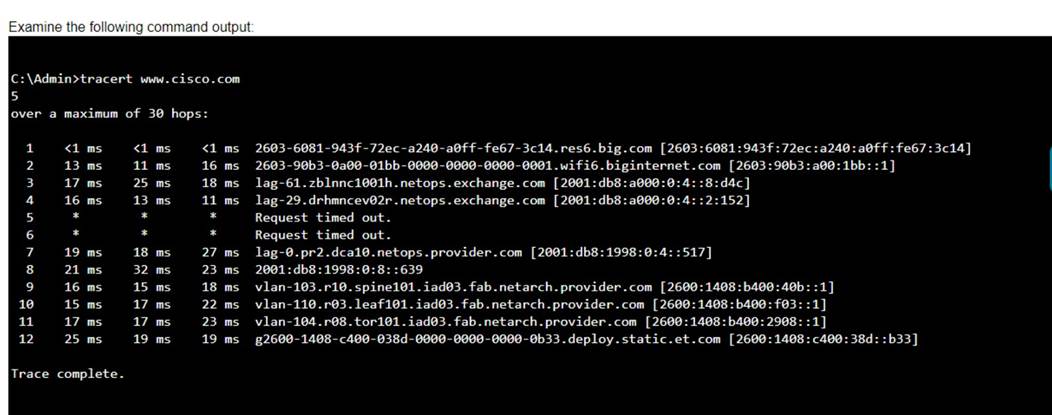
Which two conclusions can you make from the output of the tracert command? (Choose 2.) Note: You will receive partial credit for each correct answer.
Correct Answer:
AC
•Statement A: "The trace successfully reached the www.cisco.com server." This is true as indicated by the "Trace complete" message at the end, showing that the trace has reached its destination.
•Statement C: "The IPv6 address associated with the www.cisco.com server is 2600:1408:c400:38d::b33." This is true because the final hop in the trace, which is the destination, has this IPv6 address.
•Statement B: "The trace failed after the fourth hop." This is incorrect as the trace continues beyond the fourth hop, despite some intermediate timeouts.
•Statement D: "The routers at hops 5 and 6 are offline." This is not necessarily true. The routers might be configured to not respond to traceroute requests.
•Statement E: "The device sending the trace has IPv6 address 2600:1408:c400:38d::b33." This is incorrect; this address belongs to the destination server, not the sender. References:
•Understanding Traceroute: Traceroute Guide
What is the purpose of assigning an IP address to the management VLAN interface on a Layer 2 switch?
Correct Answer:
D
The primary purpose of assigning an IP address to the management VLAN interface on a Layer 2 switch is to facilitate remote management of the switch. By configuring an IP address on the management VLAN, network administrators can access the switch??s Command Line Interface (CLI) remotely using protocols such as Telnet or Secure Shell (SSH). This allows for convenient configuration changes, monitoring, and troubleshooting without needing physical access to the switch1.
References :=
•Understanding the Management VLAN
•Cisco - VLAN Configuration Guide
•Remote Management of Switches
Assigning an IP address to the management VLAN interface (often the VLAN 1 interface by default) on a Layer 2 switch allows network administrators to remotely manage the switch using protocols such as Telnet or SSH. This IP address does not affect the switch's ability to route traffic between VLANs but provides a means to access and configure the switch through its Command Line Interface (CLI).
•A: The switch does not act as a default gateway; this is typically a function of a Layer 3 device like a router.
•B: The switch does not resolve URLs; this is typically a function of DNS servers.
•C: The switch can relay DHCP requests but does not typically provide DHCP services itself; this is usually done by a dedicated DHCP server or router.
Thus, the correct answer is D. To enable access to the CLI on the switch through Telnet or SSH.
References :=
•Cisco VLAN Management Overview
•Cisco Catalyst Switch Management
Which device protects the network by permitting or denying traffic based on IP address, port number, or application?
Correct Answer:
A
✑ Firewall: A firewall is a network security device that monitors and controls incoming and outgoing network traffic based on predetermined security rules. It permits or denies traffic based on IP addresses, port numbers, or applications.
✑ Access Point: This is a device that allows wireless devices to connect to a wired
network using Wi-Fi. It does not perform traffic filtering based on IP, port, or application.
✑ VPN Gateway: This device allows for secure connections between networks over
the internet, but it is not primarily used for traffic filtering based on IP, port, or application.
✑ Intrusion Detection System (IDS): This device monitors network traffic for
suspicious activity and policy violations, but it does not actively permit or deny traffic.
References:
✑ Understanding Firewalls: Firewall Basics