
An NSX administrator has deployed a single NSX Manager node and will be adding two additional nodes to form a 3-node NSX Management Cluster for a production environment. The administrator will deploy these two additional nodes and Cluster VIP using the NSX UI.
What two are the prerequisites for this configuration? (Choose two.)
Correct Answer:
BD
For a 3-node NSX Manager cluster, all nodes must be within the same subnet to ensure proper communication and functionality between them.
A compute manager must be configured before adding nodes to the cluster, as it provides the necessary integration between the NSX Manager and the underlying virtualization infrastructure (such as vSphere or vCenter).
HOTSPOT
Refer to the exhibit.
An administrator configured NSX Advanced Load Balancer to load balance the production web server traffic, but the end users are unable to access the production website by using the VIP address.
Which of the following Tier-1 gateway route advertisement settings needs to be enabled to resolve the problem? Mark the correct answer by clicking on the image.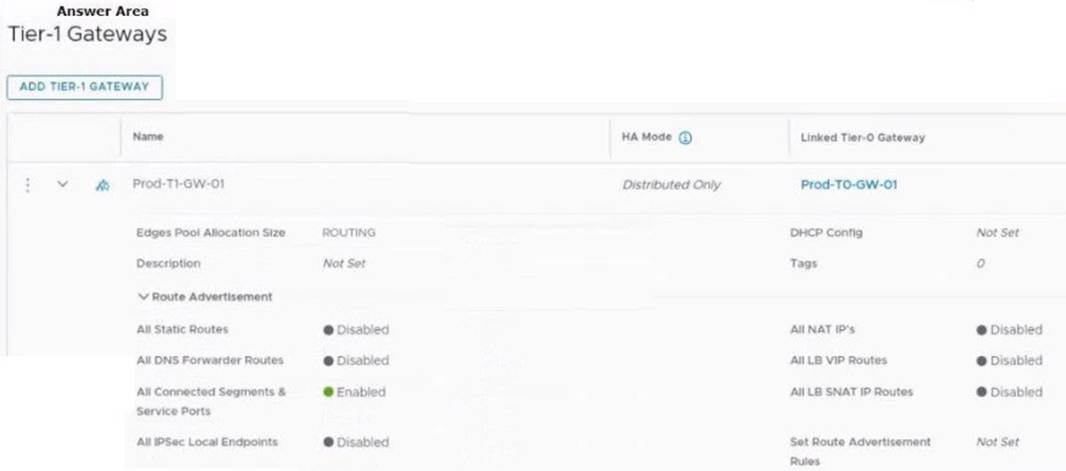
Solution:
The correct answer is to enable the option All LB VIP Routes on the Tier-1 gateway route advertisement settings. This option allows the Tier-1 gateway to advertise the NSX Advanced Load Balancer LB VIP routes to the Tier-0 gateway and other peer routers, so that the end users can reach the production website by using the VIP address1. The other options are not relevant for this scenario.
To mark the correct answer by clicking on the image, you can click on the toggle switch next to All LB VIP Routes to turn it on. The switch should change from gray to blue, indicating that the option is enabled. See the image below for reference:
Does this meet the goal?
Correct Answer:
A
Which command on ESXi is used to verify the Local Control Plane connectivity with Central Control Plane?
Correct Answer:
A
The netcpa process is responsible for Local Control Plane (LCP) connectivity with the Central Control Plane (CCP) in NSX. Using the command esxcli network ip connection list | grep netcpa, administrators can verify the connectivity status between the LCP on the ESXi host and the CCP, ensuring proper communication for NSX operations.
When configuring OSPF on Tier-0 Gateway, which three of the following must match in order to establish a neighbor relationship with an upstream router? (Choose three.)
Correct Answer:
ABE
Area ID: Both routers must belong to the same OSPF area for a neighbor relationship to form.
MTU of the Uplink: Mismatched MTU settings can prevent the OSPF adjacency from forming, as OSPF packets may be dropped if they exceed the MTU size.
Subnet mask: Both routers must have the same subnet mask on the interface where OSPF is configured to establish a neighbor relationship.
An NSX administrator would like to create an L2 segment with the following requirements:
• L2 domain should not exist on the physical switches.
• East/West communication must be maximized as much as possible. Which type of segment must the administrator choose?
Correct Answer:
B
An overlay segment is a layer 2 broadcast domain that is implemented as a logical construct in the NSX-T Data Center software. Overlay segments do not require any configuration on the physical switches, and they allow for optimal east/west communication between workloads on different ESXi hosts. Overlay segments use the Geneve protocol to encapsulate and decapsulate traffic between the hosts. Overlay segments are created and managed by the NSX Manager.
https://docs.vmware.com/en/VMware-NSX-T-Data-Center/3.2/administration/GUID- 316E5027-E588-455C-88AD-A7DA930A4F0B.html